Step 1
Start a run
Pick Solo or Multiplayer and choose Normal, Hard or Nightmare before you leave the town. Difficulty changes both the risk and the quality of drops.
Editorial contact: Raymond
How the Pixel Lineage combat system works: turn order, the Energy your skills spend, QTE attack and dodge timing, the three lives you start with before a wipe ends the run — and the stat reference behind it, from the five core attributes to the caps and multipliers that decide a build. Combat notes verified October 14, 2026.
Every run follows the same five steps, from picking a difficulty to walking out before the run goes wrong. The middle steps are the ones players skip, and skipping them is what turns a comfortable route into a wipe. Read the five steps as the shortest complete description of the Pixel Lineage combat system; every section below expands one of them. Nailing that order is the whole skill ceiling of the Pixel Lineage combat system, because a run is won by picking the right response turn after turn rather than by any one powerful ability.
Step 1
Pick Solo or Multiplayer and choose Normal, Hard or Nightmare before you leave the town. Difficulty changes both the risk and the quality of drops.
Step 2
Combat is turn-based but you still act: attacks and dodges resolve through quick-time event prompts, so the fight is decided by whether you hit the prompt rather than by a passive roll.
Step 3
Skills cost Energy and then go on cooldown. Dullahan's Headless Ride is documented as 4 energy with a 5-turn cooldown, which is the clearest example of the cost notation.
Step 4
Enemies drop equipment at Rare, Epic and Legendary levels and bosses drop better. Materials feed the Blacksmith and the Auction House.
Step 5
Return Home in the bottom-left corner exits the run and keeps the character. Walking out is cheaper than losing a Life to a fight you cannot win.
Turn order is not cosmetic: effects that fire at the start of your turn or on the first turn land before the damage does, and status effects last for a counted number of turns. Read the order before you commit to a rotation.

Starting lives
3
A character starts with three lives, and Lives are the only resource you cannot farm.
When you die
Dying costs a Life and returns you to town. Extra Lives come from code rewards and can sit in your inbox until you need one.
When you wipe
Losing every Life wipes the character and you restart from the beginning. Only certain items transfer to a new save, such as Robux wearables and event items.
Each currency answers a different problem. Gold and Knowledge are long-term progression, Potions are a one-fight answer, Energy caps your rotation, and event currency only matters while its event is live.
| Resource | What it is for |
|---|---|
| Gold | Buys potions and gear, including bids at the Auction House. |
| Knowledge | Progression currency used to upgrade your hero and to build specialised loadouts and enchantments. |
| Potions | Immediate help inside a fight: health regeneration or a power boost. Stock them before a boss, not after you start losing. |
| Energy | Pays for battle skills, which then go on cooldown. Some races and skills add energy or reduce cooldown. |
| Candy | Halloween event currency spent at the Candy Witch's stall, including 10,000 Candy for the event-only Dullahan race. |
The character sheet runs on five core attributes, and gear adds layered stats on top — offense multipliers, defensive counters and sustain effects. Knowing which layer a stat sits on matters because they do not all scale the same way.
| Attribute | What it does |
|---|---|
| Attack (Physical Power) | Increases damage dealt by basic physical hits and physical skills. |
| Magic | Increases magic damage scaling on scrolls and caster skills. |
| Defence (Armor / Guard) | Reduces damage taken from incoming physical hits. |
| Vitality (HP) | Increases maximum health pool. |
| Speed | Affects turn order and grants bonus dodge chance. |
Per-point scaling is not published, but the limits on where a point can go are. These are the numbers worth checking before you commit a run to one attribute.
| Hard limit | Value |
|---|---|
Attribute points per core stat, single run Investment in one attribute stops at 50 points. Anything beyond that has to come from gear, honing, Hall of Lineage ranks or a class evolution. | 50 |
Dodge chance Hard cap on total dodge assembled from Speed and gear passives. | 30% |
Dodge overflow Every point of dodge above the 30% cap is converted into Damage Resistance instead of being wasted. | 1% → 1% |
Converted Damage Resistance Separate cap that applies to the resistance gained from dodge overflow. | 15% |
| Percentage layer | Effect |
|---|---|
Hall of Lineage rank Account-wide, survives a wipe | +4.66% HP, Attack, Magic and Defence per rank |
Ultra Class awakening Per character, before attunement | +25% Attack, Magic and max HP |
3/3 class armour set While the full set is worn | +20% class attunement multiplier |
Blacksmith hone +1 to +10 Locked to that item | +8% of the piece's base stats per level, up to +80% |
Published level-1 baseline — Mage
76 HP · 8 Attack · 8 Defence · 22 Magic · 12 Speed · 10% crit · 5% dodge
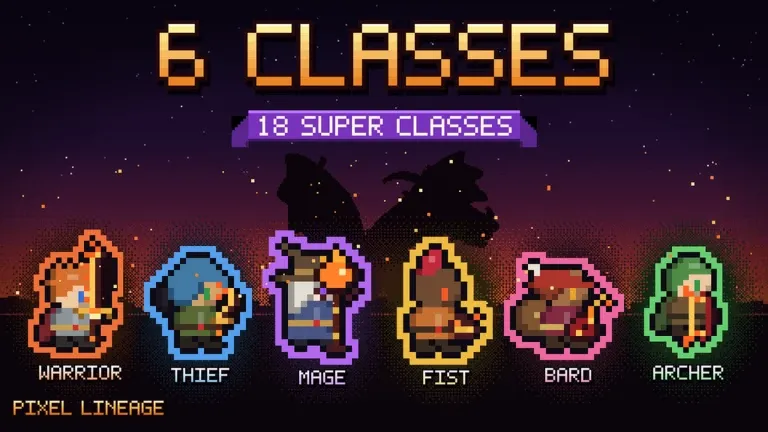
The only base class whose level-1 line is published. The other five classes shift the weight around — Warriors lean on Defence and HP, Thieves on Speed and crit — but no published baseline exists for them.
Caps and multiplier layers re-checked October 22, 2026. Talent and race percentages are item-specific and listed on their own pages.
Allocation. Level-ups during a run award stat points that you allocate on the character sheet into Attack, Vitality, Guard and Speed. A single run caps at 50 points per core stat. How many points each level awards, and what one point buys in HP or damage, is not published — so this section lists the recorded caps and percentage layers instead of a point-budget formula.
Gear is where these layers stack — the armor sets and Legendary Powers page maps the recorded effects onto these stat names.
A death costs a life, and lives cannot be farmed, so surviving one more turn outranks squeezing out one more upgrade. Learn the attack and dodge prompts on Normal before pushing a harder difficulty for better drops. Playing safe also keeps your Energy in reserve for the turns that matter, which is how the Pixel Lineage combat system rewards patience over greed.
Change one variable per run — a new race, a new talent or a new weapon — so you can attribute the result to that change. Related reading: the talent directions and the weapon picks cover the two variables you change most often.
The loop, the three-life rule and the Energy notation are documented, but the underlying formulas are not. No damage, defence or critical-hit formula is claimed here, and only one ability’s cost and cooldown are published.
For the parts of the loop that are recorded — drops and difficulty — see the dungeons guide and the weapons page.
It is turn-based, but you still act during each turn: attacks and dodges resolve through quick-time event prompts. The fight is decided by whether you hit the prompt rather than by a passive roll, so turn order matters without turning combat into a hands-off fight.
A character starts with three lives. Dying costs one life and returns you to town. Extra lives come from code rewards and can sit in your inbox until you need one.
Losing every life wipes the character and you restart from the beginning. Only certain items transfer to a new save, such as Robux wearables and event items, so moving valuable gear to another character before a risky run is a reasonable precaution.
Skills cost Energy and then go on cooldown. A low-Energy build can run out of options even at full HP, which is why a flat magic bonus and an energy bonus are usually listed together. Some races and skills add energy or reduce cooldowns.
Potions give immediate help inside a fight — health regeneration or a power boost. Stock them before a boss rather than after you start losing, because a potion spent once a fight has already turned is the least valuable one you own.
Investment in a single core stat stops at 50 points within a run, so a 50/50 split across two attributes is the practical ceiling for one character. Everything past that has to come from gear rolls, Blacksmith honing, Hall of Lineage ranks or a class evolution rather than from more level-up points.
Dodge is hard-capped at 30%. Speed and gear passives that push the rating past that point are not wasted: the excess converts into Damage Resistance at a 1:1 rate, and that converted resistance has its own 15% cap. Stacking dodge well past the cap is therefore a defensive conversion, not a dead stat.
References for this page are listed below with their scope — as plain text rather than outbound links. Community rankings and estimates are not developer announcements; check the relevant source before relying on a value that may have changed.
Reference review date .
Editorial method and limitations · Report an error on this page